

Places of the Camino
Share


The Camino de Santiago is taking off in Portugal. More and more pilgrims are choosing to walk one of the routes of the Portuguese Way, which is establishing itself as one of the Camino routes with the greatest international reach.
In 2025 alone, nearly 200,000 pilgrims traveled along one of the routes of the Portuguese Way and received their Compostela upon arriving in Santiago—a 6% increase over the previous year. Looking at each route individually, the growth of the Portuguese Coastal Way is particularly significant: nearly 20% more than the previous year.
The highest number of pilgrims was recorded on the routes running through northern Portugal and Galicia, with Tui and Porto as the main starting points.
This surge in pilgrims has been accompanied by a proliferation of lodging options, the emergence of new services such as the backpack transport service offered by Correos, and experiences designed to enhance the pilgrimage journey.
Also noteworthy is the increased effort by Portuguese institutions to promote, publicize, and protect the pilgrimage routes that cross their territory.
One of the most notable initiatives is the official certification of the routes within the country. To this end, the Portuguese government has established the Certification Commission, composed of experts in tourism and culture.
Its sole objective is to officially recognize the routes in order to ensure their protection and preserve their historical and tourist value. This translates into the maintenance of the itineraries and consistent, careful signage along the Caminos.
Certified Pilgrimage Routes in Northern Portugal
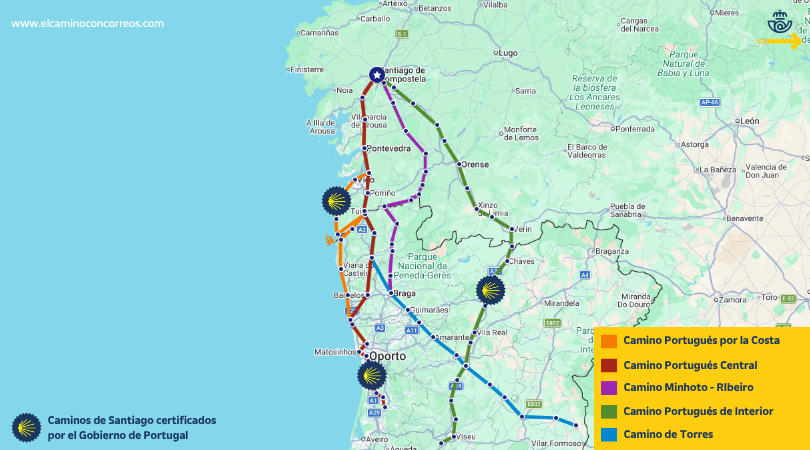
As of today, Portugal has three certified routes of the Camino de Santiago: the Central Portuguese Way, the Inland Portuguese Way, and the Coastal Portuguese Way.
Central Portuguese Way
It is the most popular Way of St. James among all the pilgrimage routes in Portugal.
Lisbon is the starting point of this itinerary, which crosses the country from south to north, passing through key locations such as Porto, Barcelos, Ponte de Lima, and Valença before entering Spain via Tui.
- Route of the Central Portuguese Way, certified in Portugal: Porto – Matosinhos – Maia – Vila do Conde – Póvoa de Varzim – Barcelos – Ponte de Lima – Paredes de Coura – Valença.
Although the Portuguese capital is its “official” starting point, most pilgrims who begin this route in Portugal set out from Porto, covering about 240 kilometers to Santiago de Compostela.
You can learn more about the Central Portuguese Way in this article.
Portuguese Coastal Way
It is the latest Portuguese Camino route to receive certification. Despite this, it is the one that has grown the most in recent years, rising from 2,600 pilgrims 10 years ago to 90,000 registered in 2025.
Porto is its starting point; it runs along the Portuguese coast to Caminha—where pilgrims must take a boat across to Galicia to reach A Guarda—or Valença do Miño, continuing along the Central Route and entering Spain via Tui.
The Portuguese Coastal Route is typically covered in 13 stages that span the 280 kilometers separating Porto from Santiago de Compostela.
-
Certified route of the Portuguese Coastal Way in Portugal: Porto – Matosinhos – Maia – Vila do Conde – Póvoa do Varzim – Esposende – Viana do Castelo – Caminha – Vila Nova de Cerveira – Valença.
We invite you to learn more about the Portuguese Coastal Way here.
Inland Portuguese Way
The last of the routes certified by the Portuguese government is the inland route. It spans 387 kilometers on its way to Santiago, starting in Viseu and passing through Chaves, before entering Galicia via Verín and continuing along the so-called Camino Sanabrés/Vía de la Plata.
- Route of the Portuguese Interior Way: Viseu – Almargem (Viseu) – Ribolhos (Castro Daire) – Bigorne (Lamego) – Bertelo (Santa Marta de Panaguiao) – Vila Real – Parada de Aguiar (Vila Pouca de Aguiar) – Vidago – Chaves – Vilarinho da Raia (Chaves).
It is, without a doubt, the most challenging Portuguese Way for pilgrims, with constant ascents and descents. The reward: beautiful landscapes dotted with vineyards and olive groves, set against the backdrop of World Heritage sites. For this reason, some pilgrims have called it the best-kept secret of the Camino routes.
The Torres and Minhoto Ribeiro Routes complete the network of trails
Although there are three certified routes, the map of pilgrimage routes in northern Portugal includes five routes to Santiago.
The number of pilgrims is lower, but the Portuguese government is already working on certifying these routes and providing services for pilgrims. We’re talking about the Minhoto-Ribeiro Way and the Torres Way.
Portuguese Way: Minhoto-Ribeiro
It is one of the oldest pilgrimage routes in Portugal, connecting the north of the country with Santiago de Compostela. Much of the route follows trails, Roman roads, and medieval paths.
It begins in Braga and passes through beautiful rural landscapes such as those of Ponte da Barca, Arcos de Valdevez, Monção, and Melgaço.
It enters Spain via the Baixa Limia, with stops in towns such as Cortegada, Arnoia, Ribadavia, and O Carballiño, before connecting in Vedra with the final stage of the Vía de la Plata route.
This makes it a unique itinerary within the Portuguese Way, as it brings together three distinctive elements that complete the pilgrimage experience: nature, thermal spas, and wine.
- Route of the Portuguese Way (Minhoto-Ribeiro): Braga – Vila Verde – Arcos de Valdevez – Sistelo (Arcos de Valdevez) – Monção – Melgaço – Cevide.
You can learn more about this route, which has not yet been certified, on its official website.
The Portuguese Way from Torres
It is the Portuguese Way, named after its most illustrious pilgrim: the Salamanca-born writer Diego de Torres Villarroel.
As you can imagine, this route connects Salamanca with Santiago de Compostela, passing through Portuguese territory. It spans 580 kilometers, during which pilgrims travel along the Cañada Real de Extremadura, the Roman Road XIX, and part of the central Portuguese Way to Santiago.
- Route of the Portuguese Route of Torres: Almeida – Pinhel – Trancoso – Sernancelhe – Moimenta da Beira – Lamego – Mesao Frio – Amarante – Felgueiras – Guimaraes – Braga – Ponte de Lima – Paredes de Coura – Valença.
Correos operates along most of these routes, offering one of the services most in demand among pilgrims: the backpack transport service.
The Paq Mochila service is available on all stages of the Camino routes from Porto to Santiago de Compostela, transporting pilgrims’ luggage from one lodging to the next.
New this year is the Paq Mochila Directo service, which allows pilgrims to send a suitcase or package directly from Porto to Santiago.
The Portuguese Way is booming, and there’s still so much to discover and experience. We hope this information helps you choose one of these routes or plan your Portuguese Way to Santiago.
Bom Caminho!
Your email address will not be published.
Mandatory fields are marked with *