
Places of the Camino
Share


The Camino de Santiago is about spirituality, hospitality, and heritage… and now it is also a privileged astronomical observatory.
On August 12, 2026, the Moon will completely block out the Sun along a path crossing northern Spain, from Galicia to the Balearic Islands.
It will be the first total solar eclipse visible from the Iberian Peninsula in more than 100 years. And many of the Camino de Santiago routes will provide a unique setting from which to observe and enjoy it.
Today, we’ll tell you more about this historic phenomenon, as well as the best times and places to watch it if you are making the pilgrimage to Santiago de Compostela.
Total Solar Eclipse and the Perseid Meteor Shower
Are you planning to walk the Camino de Santiago this August? If so, you are in for a treat. On August 12, 2026, Spain will experience a historic event: a total solar eclipse. And the Camino de Santiago will be one of the best vantage points from which to enjoy it.
Spain will be the best place in the world to witness the eclipse, as it will be visible in its full magnitude. It will begin at sunset, around 8:30 p.m., when a vast shadow sweeps across northern Spain in the opposite direction to the Camino de Santiago—from west to east.
Galicia, Asturias, Cantabria, the Basque Country, Castile and León, La Rioja, Navarre, Aragon, parts of Catalonia, and the Valencian Community will enjoy exceptional views of the eclipse, with totality visible across these regions.
In the rest of Spain, the eclipse will still be visible, but only partially, with most of the Sun obscured.
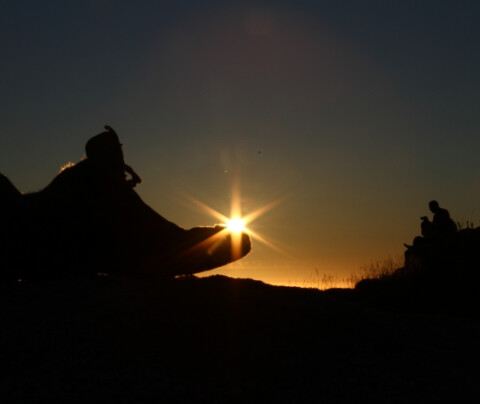
Adding to the spectacle, this historic event will occur just hours before the peak of the Perseid meteor shower. Pilgrims will therefore be able to enjoy a double celestial experience: the total solar eclipse followed by the meteor shower from the same location.
Where to Watch the Eclipse Along the Camino de Santiago
If we look at the path of totality, the English Way (Camino Inglés) will be the first Camino route to experience the eclipse. It will begin at its two starting points—Ferrol and A Coruña—from 7:30 p.m. and continue until 9:22 p.m. In Ferrol, daylight will turn into complete darkness for 63 seconds, while in A Coruña totality will last 76 seconds.
The French Way (Camino Francés) will be among the most privileged routes, as the eclipse will be visible along almost its entire length.
The path of totality will cross Galicia, Castile and León, La Rioja, Navarre, and Aragon—precisely in the opposite direction to the Camino de Santiago.
In towns and cities across Galicia, Castile and León, and La Rioja, the eclipse will reach its peak between 8:28 p.m. and 8:30 p.m. In places such as Sarria, Astorga, León, Burgos, and Logroño, total darkness will last for more than a minute.
Pilgrims walking the French Way through Navarre and Aragon will be able to enjoy a partial eclipse.
If you are one of the pilgrims choosing the Primitive Way (Camino Primitivo), you are in luck as well. Oviedo, the starting point of this historic route, will be one of the best places to witness the phenomenon, with total darkness lasting almost two minutes. The most dramatic stage of the eclipse will occur between 8:27 p.m. and 8:29 p.m.
The Northern Way (Camino del Norte) will also offer outstanding viewing opportunities. In both Cantabria and the Basque Country, day will briefly turn to night for between 30 and 60 seconds. However, in towns and cities in the province of Gipuzkoa, such as San Sebastián, the eclipse will only be visible as a partial eclipse.
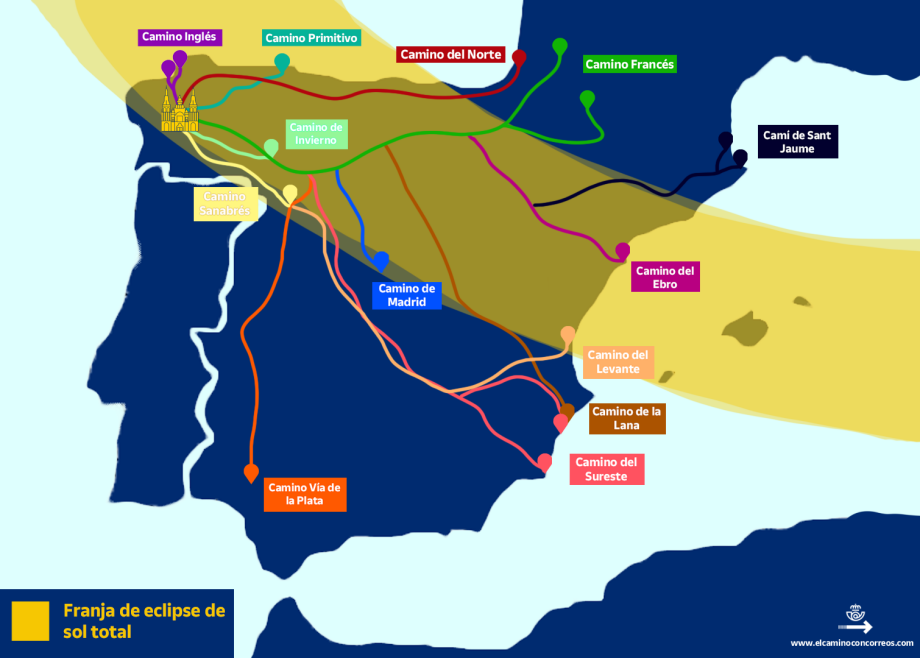
Map of the Camino Routes Where the Total Solar Eclipse Will Be Visible
Although these are the most popular Camino de Santiago routes from which the eclipse will be visible, they will not be the only ones.
The Camino de Sant Jaume, the Ebro Way (Camino del Ebro), the Wool Way (Camino de la Lana), and the Southeast Way (Camino del Sureste) will also include sections where pilgrims can experience the total solar eclipse, as will the final stretch of the Silver Route (Vía de la Plata) and the Madrid Way (Camino de Madrid).
Would you like to know whether the eclipse will be visible from the town where you are staying? Would you like to calculate the exact time it will occur? The Spanish National Geographic Institute (IGN) provides a tool that allows you to check eclipse visibility and timing municipality by municipality.
Tips for Enjoying the Eclipse on the Camino
As a general rule, you should never look directly at the Sun. The retina can be burned or partially blinded without warning, as it produces no sensation of pain. The damage can be instantaneous and irreparable if the observation is made with an optical device. This applies to both the Sun and the eclipsed Sun: the amount of solar radiation is sufficient to damage eyesight.
To observe the Sun, you must use eclipse glasses (purchased from specialized stores and planetariums). These are designed to safely observe the Sun for short periods of time, well under a minute. They should only be used if they are in good condition, without scratches, punctures, tears, breaks, or creases.
As we have already mentioned, Spain will be the best place on Earth to experience the eclipse in all its grandeur. This unique circumstance will attract not only scientists and astronomy enthusiasts, but also thousands of visitors eager to witness the phenomenon firsthand.
For this reason, we recommend booking your Camino de Santiago accommodation well in advance, especially if your itinerary coincides with areas along the path of totality.
To help with your planning, we offer our accommodation search tool, allowing you to find the option that best suits your needs. And remember that we provide a wide range of services designed for pilgrims, from backpack transport to bicycle, luggage, and parcel delivery.
It is also important to plan your journey and transport connections carefully, as the increased demand around those dates may reduce availability and drive up prices. Keep in mind that August is Spain’s peak holiday season.
Finally, to enjoy the eclipse to the fullest, we recommend finding an elevated location with an unobstructed view—free from trees, buildings, or other obstacles—particularly toward the western horizon.
We hope you have found this information useful if you are planning to be on the Camino de Santiago during the solar eclipse. And if you have not yet made plans, we encourage you to combine two truly unforgettable experiences: the pilgrimage to Santiago and a total solar eclipse.
Your email address will not be published.
Mandatory fields are marked with *