
Tips to do the Camino
Share


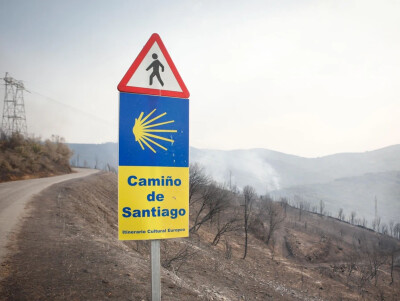
Summer and periods of high temperatures significantly increase the risk of wildfires across much of Spain. For pilgrims on the Camino de Santiago, this situation can affect both personal safety and the passability of certain stages, especially in regions with extensive forested areas such as Galicia, Castile and León, Asturias, and Cantabria.
Fires can spread rapidly due to wind, dry vegetation, and high temperatures. Therefore, in addition to knowing the routes and preparing the necessary hiking gear, it is essential to know how to prevent risks and respond correctly in an emergency.
Avoiding Risky Situations
A large proportion of wildfires are caused by humans, either through negligence or the improper use of fire in the natural environment. Pilgrims should avoid certain behaviors that could endanger the environment and the people living in it.
Do not light any type of fire—such as camping stoves, campfires, or barbecues. If you have supervision to use them, take all necessary safety precautions when lighting and extinguishing them.
Pilgrims who smoke should also take special care with cigarettes, making sure to use ashtrays and ensure they are completely extinguished. Trash is a major source of risk, so nothing should be left behind in the area.
Contacting Emergency Services
If, while walking, you see a column of smoke, flames in the vegetation, or smell a strong burning odor, it does not necessarily mean a forest fire is occurring, as controlled burns of crop stubble are often carried out and pose no danger.
However, it’s important to report it and notify the relevant authorities as soon as possible to verify whether it’s actually a fire or a controlled burn.
If it’s happening in Galicia, 085 is the Xunta de Galicia’s toll-free number to report wildfires; in the rest of Spain, you should call 112.
Once we have contacted them, we must provide as much information as possible about the emergency and its location; they will then be responsible for activating the necessary protocol and mobilizing personnel to bring the situation under control.
How to Protect Yourself from Smoke
Smoke is one of the greatest dangers of a wildfire. Inhaling gases and particles can cause difficulty breathing, dizziness, disorientation, and loss of consciousness.
For this reason, you should breathe through your nose and cover your airways with a piece of cloth—a T-shirt or a rag will work. Ideally, this cloth should be damp to protect your throat from the dry air and smoke.
If you experience symptoms such as severe difficulty breathing, chest pain, or significant dizziness, seek medical help as soon as possible.
Move as far away from the source as possible
Your top priority should always be to increase your distance from the fire. Wildfires can change their behavior in a matter of minutes and reach surprising speeds when there are strong gusts of wind or steep slopes.
Fire spreads faster uphill on slopes or inclines. Therefore, you should try to flee the fire downhill, since you’ll also be able to move much faster that way. In addition, you must take the wind direction into account. You should always head in the opposite direction to avoid the path of the fire.
Keep in mind that the wind sometimes changes direction, causing the fire front to move faster along its path. You should also be on the lookout for embers that may be carried by the wind and cause small fires outside the fire’s perimeter.
Find a safe area
Once you’ve moved away from the fire, you should look for a safe place. There are areas that act as natural firebreaks, such as rocky terrain or bodies of water. Areas that have already burned also serve as safe zones, since there is no combustible material left in them.
On the other hand, avoid taking shelter in thickets, dense pine forests, or ravines covered with vegetation, as these can act as natural chimneys and help the fire spread.
Preparation Before Starting Each Stage
Before setting out, it is advisable to check the weather forecast, wildfire warnings, and trail conditions. Being familiar with nearby Caminos, roads, hostels, and assistance points makes evacuation easier in case of danger and allows you to identify safe areas in advance.
Finally, planning alternative routes and having contact information for hostels, St. James associations, and tourist information offices makes it easier to adapt to temporary restrictions that may be imposed during a fire. In these cases, prevention and organization are just as important as knowing basic self-protection measures.
At Correos, we want to show our support for all pilgrims and the communities working to preserve the environment along the Camino de Santiago. Through our logistics and pilgrim assistance services, we will continue to help ensure that each stage of the journey can be completed with greater comfort, safety, and peace of mind—even in the face of unforeseen situations.
*Cover photo: Carlos Castro / Europa Press
Your email address will not be published.
Mandatory fields are marked with *