
Tips to do the Camino
Share


The Camino Portugués (Portuguese Way) is one of the pilgrimage routes to Santiago de Compostela that is gaining the most popularity, not only because of its beautiful landscapes, but also because it offers the chance to travel through two different countries.
If you’re planning your pilgrimage from Portugal to Spain, there are some important details you should bear in mind when crossing the border on the various routes of this Camino.
And if you’re wondering whether El Camino con Correos operates in Portugal, the answer is… YES. We don’t have any post offices in Portugal, but our Paq Mochila service – which transports your luggage from stage to stage – is available from Porto. This applies to both the Central Portuguese Way and the Coastal Portuguese Way.
Camino Portugués central
Camino Portugués, or Camino Portugués central, starts in Lisbon, although many pilgrims choose to begin in Porto for a shorter and more manageable journey.
From Porto, the route takes you through beautiful countryside and historic towns before reaching the border at Valença do Minho.
- From Valença do Minho (Portugal) to Tui (Spain): At this point along the route, you’ll come across an iconic landmark: the Tui International Bridge. This structure spanning the River Miño connects Valença do Minho with Tui by both road and rail. Of course, you can also cross it on foot.
In Valença, you can explore the Fortress, an impressive walled complex open to the public where you can go for a stroll. When you reach Tui, don’t forget to visit the Cathedral of Santa María de Tui, the first Gothic building on the Iberian Peninsula, where you can have your pilgrim’s passport stamped.
Camino Portugués de la Costa
Another very popular option is the Portuguese Coastal Way, which offers spectacular views of the Atlantic and a more leisurely route. This route also usually starts in Porto and follows the coast northwards.
- From Caminha (Portugal) to A Guarda (Spain): On this route, pilgrims encounter the largest border crossing between the two countries: the mouth of the River Miño. On this stretch, if you wish to cross over to A Guarda, you must do so by boat. The Xacobeo Transfer boat operates the route from the Puerto Sporting Club Caminhense to the A Pasaxe Ferry Terminal on Galician soil. There are also other private options known as ‘Taxi-Boats’ operating in various parts of Caminha, which disembark on the beaches of Camposancos (A Guarda). This is a unique experience lasting around three minutes, allowing pilgrims to cross this natural border.
Another option that has recently been gaining popularity amongst pilgrims on the Portuguese Way is to combine the Coastal Portuguese Way with the Central Portuguese Way. Many pilgrims therefore continue from Caminha along an eco-trail that runs alongside the river to Valença do Minho (Portugal), where they cross over to Tui, in Galicia, to continue along the inland route.
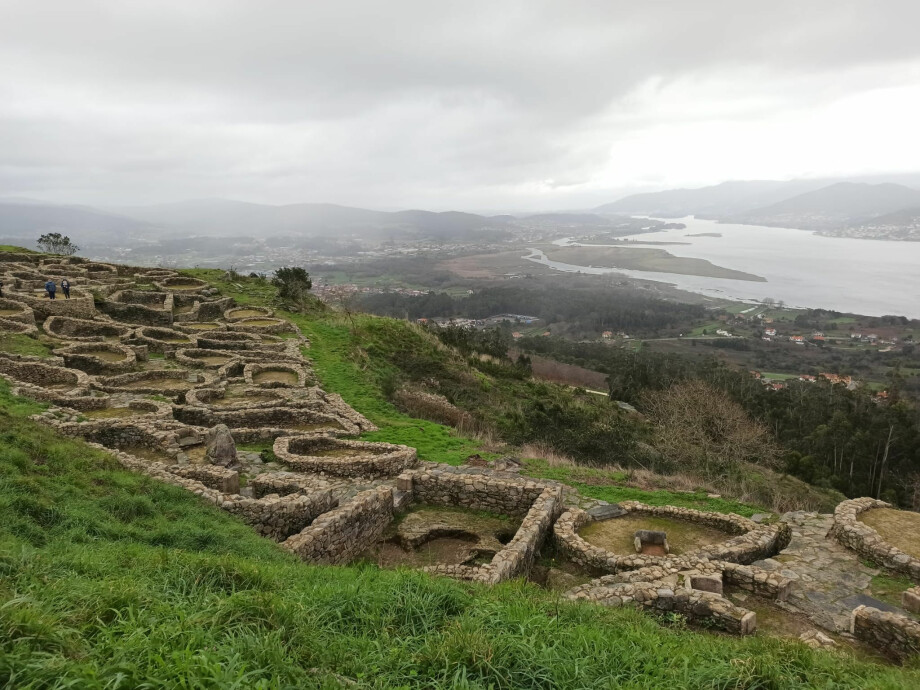
In Caminha, you can visit the fair or take a leisurely stroll through its streets, which are of great historical interest. Once in A Guarda, Monte Santa Trega is a recommended stop. Here, you’ll find archaeological remains from the Castrean-Roman culture and stunning views of the Atlantic and the Miño estuary.
-
From Vila Nova de Cerveira (Portugal) to Goián (Tomiño): For those who prefer to continue on foot and avoid any water-based experiences, an alternative outside the Jacobean route is to cross the Friendship Bridge (Ponte da Amizade).
This Portuguese town has numerous viewpoints from which to enjoy views over the Baixo Miño, such as the Deer Viewpoint (Miradouro do Cervo). Once across the bridge, you can explore any of the towns in the Baixo Miño region and admire the unique blend of river, mountains, and coastline.
Camino Portugués de interior
For those seeking a more rural and less-travelled experience, the Portuguese Inland Way (Camino Portugués del Interior) is an ideal option. The most recommended starting point is Viseu, and the route crosses the inland areas of northern Portugal.
- From Chaves (Portugal) to Verín (Spain): On this variant, the border is crossed at the small passage connecting Chaves, in Portugal, and Verín, in Galicia. Another river forms a natural border in this area: the Tâmega River. However, its lower flow makes it easy to continue the journey on foot or by bicycle without major difficulty. This section is less frequented but offers a deep connection with nature and the tranquillity of rural villages.
Chaves is renowned for its thermal springs and its castle, while Verín charms visitors with its spa heritage and the historic architecture of Monterrei Castle.
Correos Services in Portugal
f you are planning to walk the Portuguese Camino, remember that Correos offers a luggage transfer service from stage to stage, which can be booked from Porto on both the Central Portuguese Way and the Portuguese Coastal Way.
In addition, if you are starting your Camino in Porto and need to get rid of extra luggage, you can use Paq Mochila Directo. This service allows you to send a suitcase or package directly from your accommodation in Porto to Santiago de Compostela. Once you have completed your Camino, simply visit the Correos Post Office on Rúa do Franco, just a two-minute walk from Praza do Obradoiro, and collect your luggage. Please note that the office is open Monday to Sunday (including public holidays) from 8:30 a.m. to 8:30 p.m.
We also offer other services that may be useful during your Camino, which you can find here.
Whichever route variant you choose, crossing the border from Portugal to Spain is a memorable milestone on the Camino.
Enjoy the beauty of the landscape, the rich cultural heritage, and the hospitality of both countries as you make your way to Santiago de Compostela. Buen Camino!
Your email address will not be published.
Mandatory fields are marked with *