


Share


Making the Camino de Santiago a more inclusive place for everyone who walks it.
With this goal in mind, Correos and Fundación ONCE have launched Camino + Accessible, an initiative that invites you to discover tips and small actions through which we can all help improve the Camino de Santiago experience.
Camino + Accessible also brings together resources that can make the journey easier for pilgrims with disabilities or accessibility needs.
Drawing on the extensive knowledge and experience of Fundación ONCE, you can discover accessible technologies, adapted hostels, and information about the accessibility of Camino stages and other points of interest.
Will you join us in helping create a more accessible Camino?
Walking the Camino de Santiago is one of those experiences that leaves a lasting mark on you. Its landscapes, its people, its values... it is a unique journey that reaches its pinnacle when pilgrims step into Obradoiro Square and enter the Cathedral of Santiago de Compostela.
Not everything is easy on the Camino de Santiago. Covering the kilometers that separate each stage day after day represents a significant physical challenge.
However, any limitation or obstacle can be overcome. Every year, numerous associations and initiatives promote adapted Camino routes for people with special needs, demonstrating exactly that.
There is still much to be done to make the Camino de Santiago a truly inclusive place. A place where everyone can visit and enjoy it on equal terms, regardless of whether they have a disability.
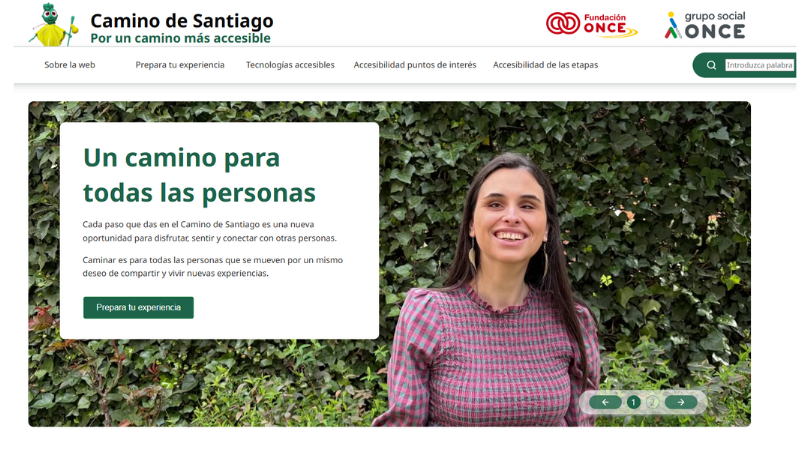
Fundación ONCE has spent many years working toward this goal. It has compiled all its knowledge and experience into a website entirely dedicated to accessibility on the Camino de Santiago.
There, visitors can find advice for planning Camino routes and various accessibility resources. Below is a summary of the most important ones, along with some additional resources.
Accessibility Resources on the Camino de Santiago
 Despite the challenges, in recent years there has been a stronger focus on accessibility along the Camino, resulting in several resources that may be useful for people who decide to undertake the journey.
Technological Resources
- Blind Explorer: This application helps people with disabilities orient themselves in natural environments using predefined routes.
The app provides real-time guidance through visual and audio cues to indicate whether users are staying on the planned route. It also describes terrain characteristics and nearby points of interest.
Thanks to Fundación ONCE, Blind Explorer includes descriptions of all stages of the French Way (Camino Francés), currently the most advanced route in terms of accessibility.
- Accessible Tourism TUR4all: Accessible Tourism for All is a collaborative platform where users can provide information about tourism establishments, resources, and services with accessibility features.
It includes descriptions of several stages of the French Way.
Stage-by-Stage Accessibility Resources
- Fundación ONCE Accessibility Guide: Once again, the French Way is ahead of other Camino routes. Fundación ONCE traveled the route from Saint-Jean-Pied-de-Port to Santiago de Compostela to create a detailed profile for each stage, including:
- Route description
- Difficulty level based on sensory accessibility
- Difficulty level based on physical accessibility
- GPS download for each stage
- Accessible Camino de Santiago Guide (Xunta de Galicia): The Xunta de Galicia also provides an Accessible Camino de Santiago Guide, containing accessibility information for all routes crossing Galician territory.
The guide is organized by locality to make resources easier to identify. It includes accessibility information for each stage and even specific sections within each stage.
Pilgrims can also find directories of services such as pharmacies, bank offices and ATMs, bicycle repair shops, and tourist information offices.
Accessibility Resources by Point of Interest
Fundación ONCE has catalogued 529 points of interest across different Camino routes and provides information about their accessibility levels.
Particularly valuable is its information on hostels along the Camino, especially on the French Way. Pilgrims can find key details, including:
- Whether the hostel is wheelchair accessible
- Whether rooms are available for people with reduced mobilityWhether adapted toilets are available in common areas
In addition to hostels, Fundación ONCE's search tool provides accessibility information for other locations such as pharmacies, tourist offices, and Correos offices along the Camino.
Tips for Contributing to a More Accessible Camino
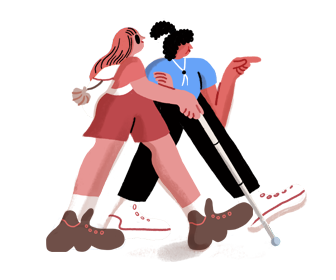 Continuing to improve accessibility is essential for creating a more inclusive Camino de Santiago.
However, each of us can also help through a series of small actions. We invite you to join us:
- Promote active support. Offer help naturally and respectfully during stages when you encounter pilgrims who may require specific assistance.
- Share accurate information. Post reviews about the condition of ramps, adapted restrooms, and access points on travel and mapping applications.
- Spread useful information. Share accessibility resources, maps of adapted stages, and guides to inclusive hostels.
- Raise awareness. Give visibility to volunteering and support projects for pilgrims with disabilities.
- Collaborate with specialized organizations. Volunteer or act as a guide in initiatives that promote accessible pilgrimages, assisting people with reduced mobility or visual impairments.
- Adapt your local business. If you manage accommodation or a hospitality business along the route, seek advice on removing physical barriers and improving signage through pictograms or easy-to-read formats.
- Promote inclusion. Encourage equal and prejudice-free treatment of people with disabilities among fellow pilgrims and accommodation providers.
Correos, in collaboration with the ONCE Foundation, is launching this initiative with the goal of promoting accessibility so that people with disabilities can walk the Camino de Santiago.
Camino + Accesible includes the printing of 1,000 postcards that will be distributed free of charge at lodging facilities along the Camino, featuring information about the campaign, which calls on everyone to work together to make the Camino de Santiago more inclusive.
The postcards, designed by artist Cinta Arribas, aim to raise awareness about the importance of making the Camino an accessible experience for everyone, regardless of whether they live with a disability.


It has also designed a special certificate to be issued at its Santiago office in order to highlight the significance of pilgrimages for people with disabilities.
Finally, Correos is expanding the use of NAVILENS on its signage to help people with visual impairments, in particular, find their way around and access information about its services.
Creating a truly inclusive Camino de Santiago is a shared responsibility. Public administrations, organizations, businesses, hostel managers, and pilgrims all have the opportunity to contribute so that everyone can enjoy this experience on equal terms. Today, more resources, information, and tools than ever are available to help us move toward a barrier-free Camino.
Your email address will not be published.
Mandatory fields are marked with *